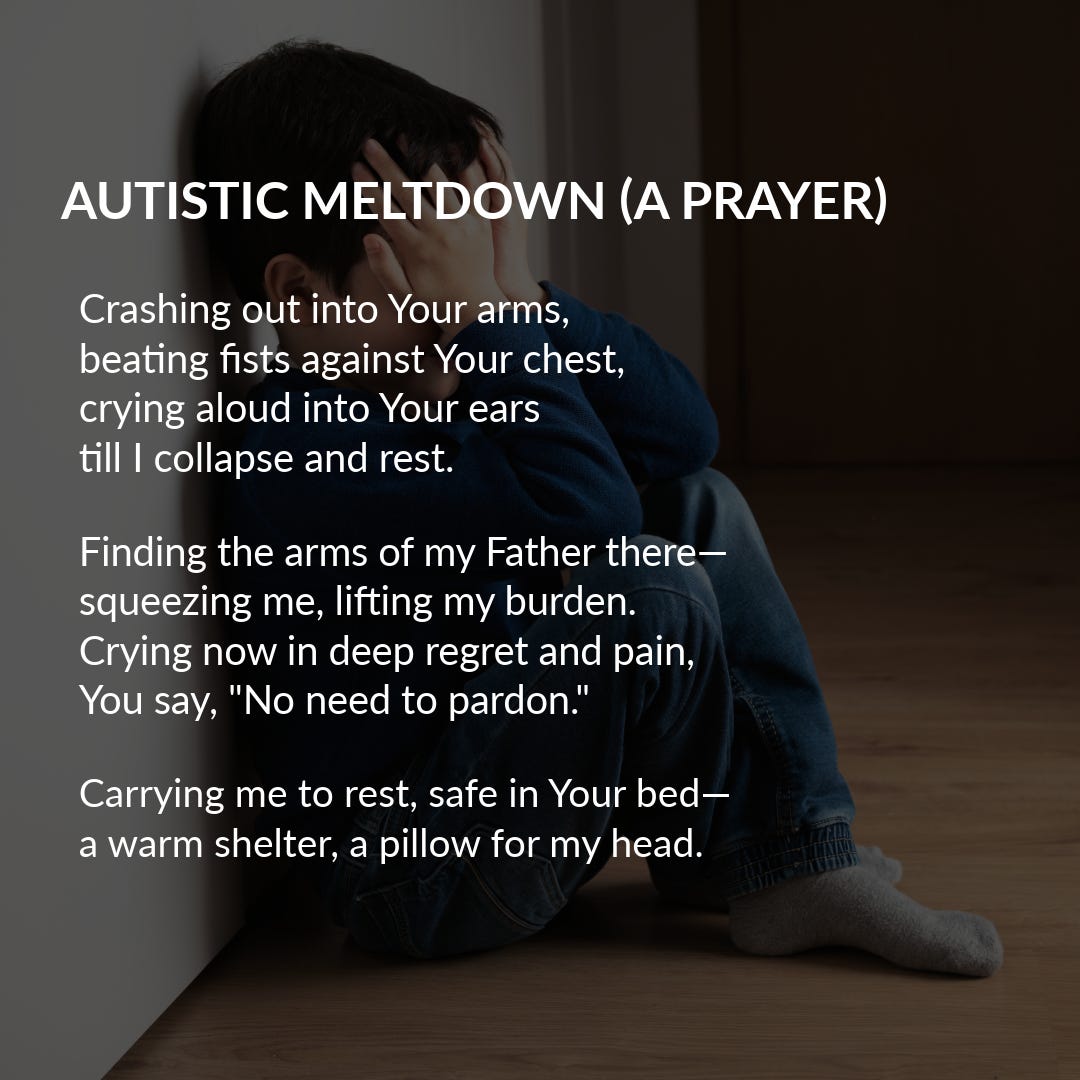
Autistic Meltdowns and Prayer
Parenting Through Autism Meltdowns: Faith, Patience, and Biblical Perspective

My oldest son has Level 3—or Severe—Autism. He is one of the happiest and most joyful kids I know that he is wonderfully made in the image of God (Genesis 1:27; Psalm 139:13–14). Yet one of the often unseen and undiscussed aspects of Autism is the struggle with emotional regulation. I have witnessed him at the highest highs and the lowest lows.
A meltdown—or to use more proper medical terms, an “acute behavioral dysregulation” or “emotional dysregulation episode”—is a common occurrence for children like mine. These episodes happen because of how his brain functions. They are often triggered by sensory or emotional overload: loud noises, bright lights, strong smells, crowded spaces, or unexpected physical touch. Whereas a neurotypical brain can process these things, his brain struggles to self-regulate and calm down because of its wiring.
For us personally, these episodes can mean intense crying or screaming. Sometimes it involves self-harming behaviors like banging his head into a wall. One of the techniques I’ve relied upon is a tight bear hug followed by counting and praying. Sometimes these episodes last for hours on end. He will punch, bite, claw, and scream. Yet sometimes restraint is what’s best to keep him and others safe.
This is my job and no one else’s. He is my son. I can take the beating. I am strong enough, and he is mine, and I love him. Eventually comes the moment of exhaustion, and he collapses into my arms in sleep.
As a parent, these moments break your heart because you know they are not tantrums. I also have a neurotypical toddler and have seen a tantrum. This is different. I am hesitant to share this online because, far too often, the “solutions” people offer are horrifying. I’ve been told to simply “beat my child,” and some go into horrific detail, claiming Autism “did not exist” when they were children and that their parents would have “beaten it out” of them.
Just to be clear, I am not against corporal discipline. But biblical discipline requires a few things:
It is always corrective, seeking the growth and obedience of the child (Proverbs 13:24; Ephesians 6:4).
It is never done in anger or retaliation (James 1:19–20).
As I reflect on these moments of parenting, I am reminded of how my heavenly Father handles me. When my emotions are out of sync, when I am angry or inconsolable, when the weight of this world is crushing my spirit, I can run to my Father in heaven and find His arms holding me. His ear to cry into. His chest to pound against.
He can take it. He is strong enough. He can take my burden and calm me until I am still (Psalm 55:22; Matthew 11:28–29).
The prayers in Scripture—especially the Psalms—show that when God’s people were in deep distress, their prayers were not formal, but personal, real, and raw (Psalm 13; Psalm 42; Lamentations 3). God can handle our complaints. He is strong enough to hear our real thoughts. He is safe enough to collapse into (Psalm 34:18).
In holding my son through his meltdowns, I’ve learned something of how God holds me through mine.