
Taking No For An Answer
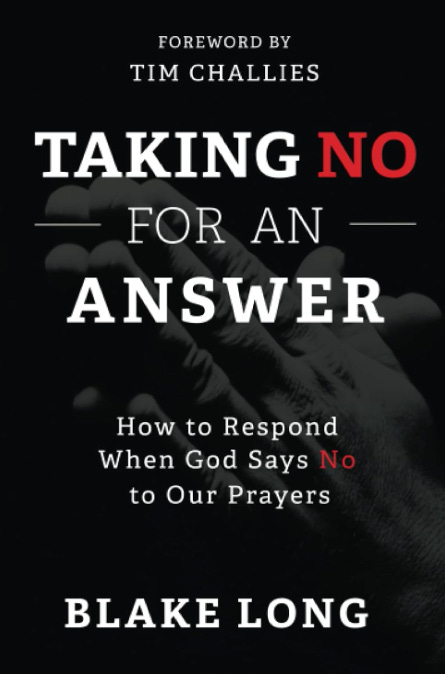
A Book Review and Recommendation

“Some of God’s greatest gifts are unanswered prayers.” – Garth Brooks.
Theologically speaking, there is no such thing as an unanswered prayer. Every cry to God receives a response—though sometimes, that response is a clear and resounding no.
In Taking No For An Answer, Blake Long tackles one of the hardest spiritual realities: how to remain faithful when our most earnest prayers seem denied. Long holds a B.S. in Mass Communications from East Central University and earned a Master of Theological Studies in Preaching and Pastoral Ministry from Midwestern Baptist Theological Seminary. He now works for a philanthropic nonprofit in his hometown and serves as a small group leader at Sovereign Grace Bible Church, where he and his family are covenant members.
This book feels particularly urgent in our current evangelical moment. A soft form of the prosperity gospel has crept into even the most conservative corners of the church. It may not promise jets or jewels, but it still whispers that if we just believe enough, pray the right words, or “declare victory,” then God must move. As a father to a child with disabilities, I’ve seen the wreckage this theology leaves behind. When healing doesn’t come, when suffering continues, the blame is too often placed on the shoulders of the brokenhearted—as if their faith simply wasn’t strong enough.
But Scripture tells a different story.
Long’s writing is pastoral, accessible, and theologically rich. In one section he walks readers through the lives of biblical figures who received divine “no’s”:
David, whose desire to build the temple was denied and whose prayer for his dying infant son was denied.
Paul, who begged for his thorn to be removed but was instead told, “My grace is sufficient for you”
Jesus, who prayed in Gethsemane for the cup to pass—but ultimately submitted, “Not my will, but Yours be done”
Each of these moments reveals something profound: God’s “no” is never arbitrary, and never without purpose. Sometimes, it is the very mechanism by which we are conformed to the image of Christ. Long helps readers ask and wrestle with the right questions—How do we trust when the heavens feel silent? How do we pray when we know the answer might be painful? What does faithfulness look like when dreams die?
This book is not a manual on how to get what you want from God. It’s a call to deeper trust, deeper worship, and a more robust theology of suffering and prayer. I highly recommend it to anyone who has prayed with tears and walked away with empty hands—only to discover, eventually, that Christ himself was enough.
Favorite Quotes
“David begged God to spare the child” (2 Samuel 12:16 NLT). As Nathan returned home, God sent a deadly illness upon David and Bathsheba’s son. And as we see in this verse, David pleaded with the Lord to keep his son alive, to spare him. For seven days, David prayed and fasted, begging the Lord to heal his son. (p. 32)
Here we see David living coram Deo, before the face of God. David plead his case before the throne of the Almighty—and lost. Yet he was willing to bow before the providence of God, to let God be God. (p. 33).
Like the Apostle Paul, we mustn’t look at God’s answer with discouragement, but opportunity. Opportunity to trust in the Lord’s unwavering, unconquerable grace. (p. 36).
Is Christ enough when you can’t seem to find a job that supports your family? Is Christ enough when it feels like everybody is out to get you? Is Christ enough when a loved one died unexpectedly? Is Christ enough when you are on your deathbed? (p. 49).
THE WHOLE MESSAGE of this book is centered on our response to unanswered prayer. God tells us no often, and we are responsible for responding in a godly manner. Ultimately, God tells us no for two reasons: our good and his glory. (p. 115).